
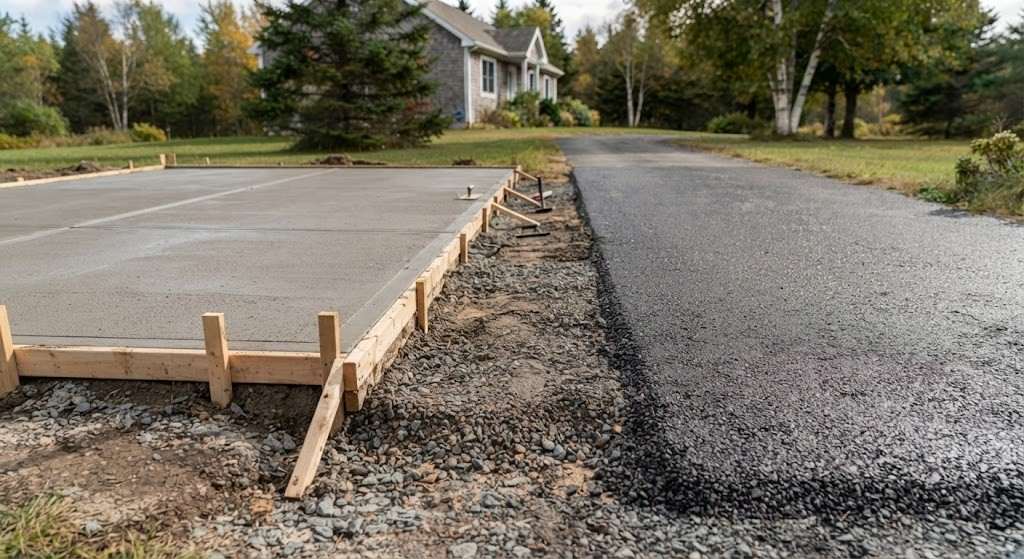
Quick answer: Most residential concrete slabs, including walkways, patios and car driveways, should be at least 100 mm (4 in) thick, rising to 125–150 mm (5–6 in) for trucks, RVs or heavy loads. An asphalt driveway typically needs 50–75 mm (2–3 in) of compacted asphalt over 150–200 mm (6–8 in) of compacted gravel base. In Nova Scotia, the depth and drainage of that base matter as much as the surface thickness.
Thickness is one of the few decisions you can’t change after the job is done. Too thin, and a slab or driveway cracks, ruts or breaks at the edges within a few winters. Too thick, and you pay for material that adds little value. This guide answers how thick a concrete slab should be for each common use, how thick an asphalt driveway or parking lot needs to be, and why the gravel underneath often decides whether either one lasts.
Recommended Thickness at a Glance
| Project | Concrete thickness | Asphalt thickness (compacted) | Compacted gravel base |
|---|---|---|---|
| Walkway or sidewalk | 100 mm (4 in) | 50 mm (2 in) | 100–150 mm (4–6 in) |
| Patio | 100 mm (4 in) | Not typical | 100–150 mm (4–6 in) |
| Driveway, passenger cars | 100–125 mm (4–5 in) | 50–75 mm (2–3 in) | 150–200 mm (6–8 in) |
| Driveway with trucks, RVs or trailers | 125–150 mm (5–6 in) | 75–100 mm (3–4 in) | 200–300 mm (8–12 in) |
| Garage or shed slab | 100–125 mm (4–5 in) | Not typical | 100–150 mm (4–6 in) |
| Light-duty commercial parking lot | Engineered design | 75–90 mm (3–3.5 in) in two lifts | 200–300 mm (8–12 in) |
| Loading areas and equipment pads | Engineered, often 150 mm+ | Engineered, often 100 mm+ | Engineered |
These ranges are common Canadian starting points for well-drained, firm soil. Soft ground, steep slopes, poor drainage and heavy loads all call for more, and commercial pavements should always be designed for the traffic they will carry.
How Thick Should a Concrete Slab Be? Thickness by Use

Walkways, Sidewalks and Patios
For pedestrian areas, 100 mm (4 in) of concrete on a compacted granular base is the long-standing residential standard. Thinner slabs save little and crack easily when a lawn tractor, wheelbarrow full of stone or delivery cart rolls over them. If a walkway also serves as a parking apron or carries small vehicles, increase it to 125–150 mm.
Concrete Driveways
Canadian concrete industry guidance calls for a minimum of 100 mm (4 in) for driveways used by passenger vehicles, and 125 mm (5 in) or more where larger trucks or RVs will park. In a freeze-thaw climate like Nova Scotia’s, building at 125 mm even for cars adds stiffness against frost movement for a modest increase in cost. The thicker section matters most at the apron, where vehicles turn and plows push.
Garage Floors and Shed Slabs
A typical residential garage or shed slab is 100–125 mm thick. Go thicker where you’ll store heavy equipment, park a work truck or set point loads such as a car hoist, which needs a slab designed for the manufacturer’s anchor requirements.
Load-Bearing Slabs and Equipment Pads
Slabs for generators, transformers, tanks, machinery or heavy vehicles are a different category. Their thickness and reinforcement should come from an engineered design based on the load, the soil and the equipment’s anchoring needs. Our concrete slab installation work covers residential pads through commercial and utility slabs, built to the specified thickness on a properly prepared base.
How Thick Should an Asphalt Driveway Be?
A residential asphalt driveway typically needs 50–75 mm (2–3 in) of compacted asphalt. Many contractors place it in two lifts: a coarser base layer for strength and a finer surface layer for a smooth, tight finish. Driveways that see delivery trucks, trailers or RVs should move up to 75–100 mm.
The word “compacted” matters. Hot asphalt is spread thicker than its final depth and shrinks as rollers compress it, so a layer laid at about 75 mm (3 in) can finish closer to 63 mm (2.5 in). When comparing quotes, ask for the compacted thickness, not the loose depth.
Parking lots follow the same logic at a larger scale. Light-duty lots for cars commonly use around 75–90 mm of asphalt in two lifts over a deeper granular base, while truck routes, loading areas and drive-throughs need thicker, engineered sections.
Why the Gravel Base Matters More Than the Surface
The base does most of the structural work. A well-compacted layer of crushed gravel spreads each wheel load over a wider area, so the soil beneath never feels the full weight. It also gives water somewhere to drain, which is critical in a freeze-thaw climate.
A thick surface on a weak base fails anyway. Extra asphalt or concrete can’t compensate for soft clay, organic soil or a base that holds water. That’s why good paving starts with excavation to stable ground, a free-draining gravel base compacted in layers, and grading that moves water away. On softer soils, a geotextile fabric between the subgrade and base keeps the two from mixing over time.
Site conditions across HRM range from shallow ledge rock to wet, fine-grained soils, so the right base depth varies from property to property. As an excavation and heavy civil contractor in Halifax, G&R Kelly assesses the ground first and builds the base to suit it before any surface goes down.
Reinforcement, Joints and Edges for Concrete Slabs
- Reinforcement: Industry guidance notes that reinforcing steel or fibres aren’t strictly required in residential driveways, but they are often used. Wire mesh or rebar doesn’t stop cracks from forming, but it holds cracked sections together and keeps them tight.
- Control joints: Concrete shrinks as it cures, so planned joints give cracks a place to form. Joints should be cut or tooltied to at least one-quarter of the slab depth, and a common rule of thumb spaces them, in feet, at two to three times the slab thickness in inches. For a 100 mm (4 in) slab, that means a joint roughly every 2.4–3.6 m (8–12 ft).
- Thickened edges: Edges and aprons take the most punishment. Thickening the slab along exposed edges adds strength where tires, plows and frost hit hardest.
- Isolation joints: A full-depth joint where the slab meets a foundation, garage floor or existing walkway lets each piece move independently.
What Happens When a Driveway or Slab Is Too Thin
Under-built pavement fails in predictable ways. Concrete develops corner breaks and random cracks across the slab instead of at the joints. Asphalt ruts in the wheel paths, crumbles at the edges and develops alligator cracking where the surface flexes too much over the base. Each crack lets in water, and Nova Scotia’s freeze-thaw cycles do the rest.
The savings from a thinner section are usually small compared with the cost of early repairs or a full replacement. If you’re still deciding which surface fits your property and budget, our asphalt vs concrete driveway comparison covers cost, lifespan and winter performance side by side.
How Nova Scotia Conditions Change the Numbers
Local climate pushes the case for building on the thicker side of each range. Frequent freeze-thaw cycles, wet winters and spring thaw all weaken bases that hold water. De-icing salt adds stress to exterior concrete, which is why Canadian practice uses air-entrained concrete for exterior flatwork; CSA A23.1 Class C-2 concrete specifies 32 MPa strength and 5–8% air content.

Slope and drainage matter too. Steep driveways need well-anchored edges and good water control so runoff doesn’t scour the base. Low spots that collect water need regrading or drainage before paving, not just a thicker surface on top.
Questions to Ask Your Contractor About Thickness
A clear quote protects you. Before signing, ask:
- What compacted thickness of asphalt, or finished thickness of concrete, is included?
- How deep is the gravel base, what material is used, and how is it compacted?
- Will the subgrade be excavated to stable soil, and is geotextile fabric needed?
- For concrete, what strength and air content is specified, and where will joints go?
- How will water drain away from the new surface?
A contractor who answers these in writing is planning for the long term.
Frequently Asked Questions
Is 4 inches of concrete enough for a driveway?
Yes, 100 mm (4 in) is the accepted minimum for driveways used by passenger cars on a well-prepared base. Choose 125 mm (5 in) or more for trucks, RVs, trailers or softer soils.
Is 2 inches of asphalt enough for a driveway?
Two inches (50 mm) of compacted asphalt is the bottom of the residential range and works only on a strong, well-drained base with light cars. For most Nova Scotia driveways, building toward the upper end of the range, around 65–75 mm, gives a better margin against frost and heavier vehicles.
How thick should a concrete patio be?
A standard concrete patio should be 100 mm (4 in) thick over a compacted gravel base. Add thickness where a hot tub, heavy planters or an outdoor kitchen will sit.
How thick should a parking lot be?
Light-duty car parking lots commonly use 75–90 mm of asphalt over 200–300 mm of compacted granular base. Areas with trucks, buses or deliveries need a thicker, engineered pavement design.
How deep should the gravel base be under a driveway?
Most residential asphalt driveways use 150–200 mm (6–8 in) of compacted gravel, and more on soft or poorly drained soils. Concrete driveways need less, typically 75–150 mm of compacted granular base, because the slab itself spreads the load; the key is uniform support with no soft spots.
Does a thicker concrete slab need rebar?
Not always. Many residential slabs perform well without it, but rebar or wire mesh is recommended for heavy loads, poor soils or wherever you want cracks held tightly together. Structural and equipment slabs should follow an engineered design.
Get the Thickness Right the First Time
G&R Kelly has built bases, slabs and pavement across Nova Scotia since 1969, from residential driveways to commercial lots and municipal streets. We’ll assess your soil, drainage and loads, then recommend the right thickness for both the surface and the base. Request a free paving or concrete estimate and get a detailed written quote that spells out every layer.