
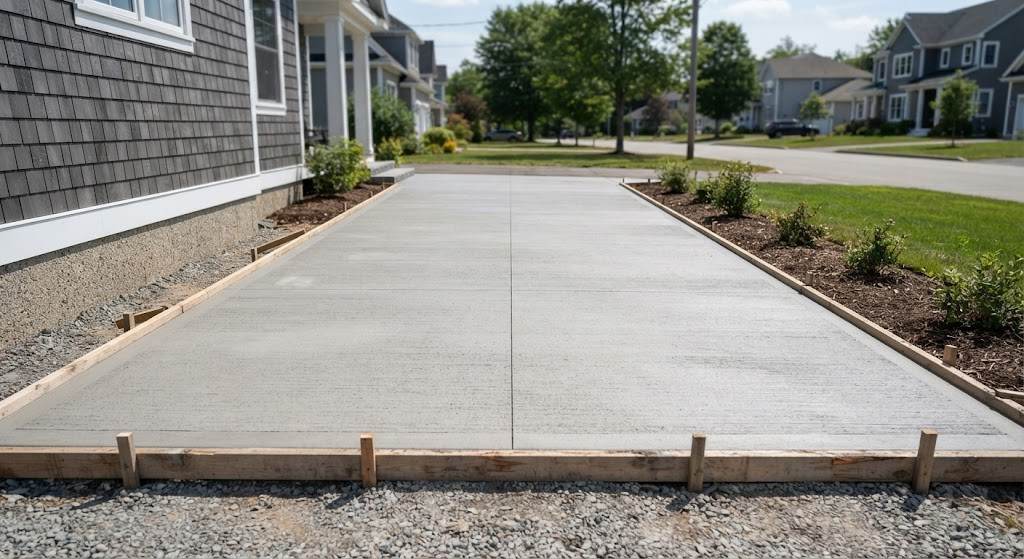
Quick answer: Concrete takes about 28 days to fully cure and reach its design strength. You can usually walk on it after 24 to 48 hours and drive a car on it after about 7 days, when it has reached roughly 70% of its strength. Cold weather below 5°C slows curing, so fall pours in Nova Scotia need protection.
New concrete looks hard within hours, but it is far from finished. Using a driveway, sidewalk or slab too early is one of the most common reasons concrete cracks, scales or wears out before its time. This guide answers the question “how long does concrete take to cure?”, explains what happens at each stage, and shows how Nova Scotia weather changes the timeline.
Concrete Curing Timeline at a Glance
| Time after pour | What’s happening | What you can do |
|---|---|---|
| 0–12 hours | Initial set; surface is finished | Keep off completely; protect from rain and frost |
| 24–48 hours | Early hardening | Light foot traffic; forms often removed |
| 3 days | Roughly 40–50% strength | Careful foot traffic; no wheels or heavy objects |
| 7 days | About 70% strength | Cars and light vehicles on driveways |
| 28 days | Full design strength | Heavy vehicles, equipment and sealing |
Curing vs Drying: What’s the Difference?
Concrete does not harden by drying out. It hardens through hydration, a chemical reaction between Portland cement and water that forms crystals binding the sand and stone together. That reaction needs moisture and moderate temperatures to continue.
If the surface dries too quickly, hydration stops near the top. The result is a weak, dusty surface that is more likely to crack, scale and wear. That’s why proper concrete curing means keeping new concrete moist and protected, not simply leaving it to dry.
What Happens During Each Stage of Curing?

The First 24 to 48 Hours
During the first day, concrete moves from a workable paste to a hardened material. This is when it is most vulnerable to rain damage, early drying and freezing. Contractors finish the surface, cut or tool control joints, and apply a curing method right away.
Days 3 to 7
Strength climbs quickly in the first week. By day seven, most concrete reaches about 65–70% of its specified strength. For a residential driveway, that is generally enough for passenger vehicles, as long as you avoid sharp turns and parking at the edges.
Day 28 and Beyond
Twenty-eight days is the industry benchmark for full design strength, and it is the point at which concrete strength is tested and specified. Concrete keeps gaining small amounts of strength for months afterward, but day 28 is when heavy trucks, equipment and sealers are generally safe.
How Nova Scotia Weather Affects Curing Time

Temperature has the biggest effect on curing. Hydration slows sharply in cold conditions, and freshly placed concrete that freezes can lose much of its strength and durability. Canadian practice under CSA A23.1, the national standard for concrete construction, calls for cold-weather protection when air temperatures drop below 5°C.
In Nova Scotia, that matters most for late-fall and early-spring pours. As a Nova Scotia heavy civil contractor working through every season, G&R Kelly protects fresh concrete with insulated curing blankets or adjusted mix designs that gain strength faster.
Hot, windy or sunny days cause the opposite problem. The surface loses moisture too fast and can develop plastic shrinkage cracks. Shading, wind breaks and wet curing help prevent this.
Rain is a risk mainly in the first few hours, before the surface sets. After that, light rain actually helps curing by keeping the concrete moist.
What Else Affects How Long Concrete Takes to Cure?
- Mix design: The water-to-cement ratio, cement type and admixtures change how fast strength develops. Accelerators speed it up for cold weather.
- Thickness: Thicker slabs hold heat longer and cure more evenly than thin sections.
- Air entrainment: Exterior concrete in Canada is air-entrained to resist freeze-thaw cycles and de-icing salt. CSA A23.1 Class C-2 concrete, used for exterior flatwork exposed to salt, typically specifies 32 MPa strength and 5–8% air content.
- Curing method: Wet curing, plastic sheeting and spray-on curing compounds all slow moisture loss and produce stronger, more durable surfaces.
How Contractors Cure Concrete Properly
Good curing starts the moment finishing ends. Common methods include spraying a liquid curing compound that forms a moisture-retaining film, covering the slab with plastic sheeting or wet burlap, and keeping the surface damp with misting for the first several days.
For curbs, sidewalks, steps and slabs, our concrete contractors in Halifax also plan the pour around the forecast. Scheduling, blankets and the right mix for the season prevent most curing problems before they start.
When Can You Seal or Salt New Concrete?
Wait at least 28 days before applying a penetrating sealer, so moisture can escape and the surface can reach full strength. Sealing then helps protect exterior concrete from water and salt.
During its first winter, avoid de-icing salt on new concrete whenever possible. Salt increases freeze-thaw stress on a young surface and is a leading cause of scaling. Use sand for traction instead, and clear snow promptly.
Signs Concrete Was Not Cured Properly
Poor curing usually shows up within the first year or two. Watch for:
- A dusty, chalky surface that wears away under foot traffic
- Scaling or flaking, especially after the first winter
- Crazing: fine surface cracks that spread into a web-like pattern
- Low strength, with edges and joints that chip easily
Once these problems appear, the damaged section usually needs repair or replacement. Proper curing from day one is far cheaper than fixing it later.
How Concrete Compares With Asphalt
Concrete needs about a week before cars and four weeks for full strength. Asphalt cures on a very different schedule because it hardens by cooling rather than through a chemical reaction. If you’re comparing materials or planning a paving project, read our guide on how long asphalt takes to cure before you can drive on it.
Frequently Asked Questions
How long does concrete take to set and dry?
Concrete reaches its initial set within a few hours and is dry to the touch within about a day, but setting, drying and curing are different stages. Concrete keeps curing for 28 days to reach full strength, and slabs can take weeks longer to fully release internal moisture.
Can I walk on concrete after 24 hours?
Usually, yes, for light foot traffic in mild weather. Avoid dragging objects, wearing cleats or walking near fresh edges. In cold weather, wait 48 hours or longer.
When can I drive on a new concrete driveway?
Most driveways can handle passenger cars after about seven days. Wait 28 days before parking heavy trucks, trailers or RVs on the slab.
Does concrete cure faster in hot weather?
Concrete gains strength faster when it is warm, but hot, dry or windy weather can dry the surface too quickly and cause cracking. Moist curing keeps the process on track.
Can concrete cure in the rain?
Rain can pit and weaken the surface in the first few hours, before the concrete sets, so contractors cover fresh pours when rain is forecast. Once the surface has hardened, usually after about 12 hours in mild weather, rain does no harm and helps keep the concrete moist while it cures.
Planning a Concrete Project in HRM?
G&R Kelly has worked on concrete, excavation and paving projects across Nova Scotia since 1969. As a family-owned company, we handle the base, the forming, the pour and the curing on every job. Learn more about G&R Kelly and our team, or call (902) 835 3125 to discuss your curbs, sidewalks, slabs or driveway.
Sources: Cement Association of Canada, Residential Concrete Flatwork Guide (CSA A23.1 Class C-2); CSA A23.1, Concrete materials and methods of concrete construction.